Taming the raging AI bull: a take on human-centred design in 2026
If 2025 felt like the year we all sprinted into the AI buffet with no portion control, then 2026 is the year we realise the buffet is actually a raging bull.
By Juvan Nortje. Originally published on LinkedIn.
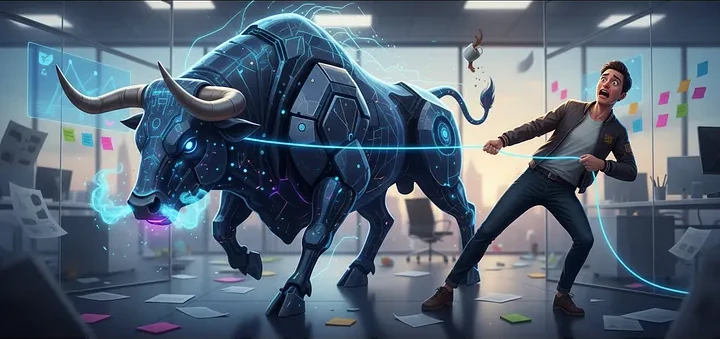
And it’s been charging at us while we’ve been busy tweaking colour palettes.
AI didn’t just “arrive” in 2025. It crashed into design, development, product and business with full force. Every week brought a new tool, a new model, a new “must-try” workflow, and yet another subscription. The big question quietly shifted from “How do we innovate?” to “Where on earth do I start, and why am I suddenly paying for eight different AI platforms?”
What 2025 really gave us was possibility. What it didn’t give us was clarity.
From explosion to intention: what changes in 2026
In 2026, simply “using AI” is no longer a differentiator. Everyone uses AI now. Tools are ubiquitous. Models are everywhere. The real differentiator is how intentionally we use them.
The advantage belongs to the people who can tame the AI bull: those who blend hard-earned industry experience with emerging technology, who stay rooted in human-centred design (HCD), and who use tools like vibe-coding and MCPs with purpose rather than panic.
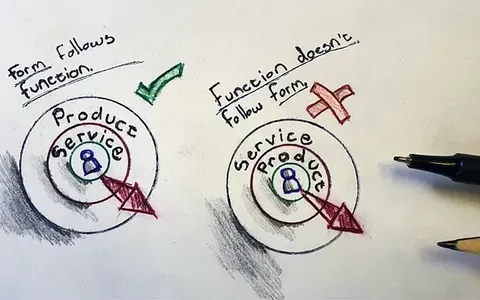
For me, as a human-centred product and service designer, the core problem hasn’t changed: we are still designing for people. AI is a powerful delivery engine, but HCD remains the steering wheel. Without it, you’re just accelerating towards nowhere in particular, very efficiently.
Vibe-coding and MCPs: accelerators, not autopilots
Let’s talk about vibe-coding and MCPs, because they’re often misunderstood.
Vibe-coding, in my experience, is not about handing your work over to AI and hoping for the best. It’s about using natural language and intent to guide systems that can generate concepts, structures and even code in a way that aligns with your vision. It reduces the friction between what’s in your head and what appears on the screen. Used correctly, it can turn that gap from a road into a footpath.
MCPs (Model Context Protocols) add another dimension. They act as bridges between models, tools, data and contexts. They allow different systems to “talk to each other” in structured ways, giving you more consistency and control across your workflow. Instead of wrestling with disconnected tools, you start orchestrating them.
Used mindfully, vibe-coding and MCPs are incredibly effective at generating quick sources of inspiration. They help you explore multiple directions rapidly, visualise possible service and product outcomes, and test variations without committing weeks of effort. They can show you “what if” views of your product, your service or your customer journey in a fraction of the time you’d traditionally spend.
But here’s the key: they are at their best when they amplify human intention, not replace it.
Speed without direction is still chaos
One of the biggest risks I see in 2026 is confusing speed with progress.
Yes, vibe-coding and MCPs can produce polished-looking outputs faster than ever before. But that doesn’t automatically make those outputs meaningful, usable or ethical. Speed without direction is just chaos in fast-forward.
This is where experience and human-centred design become non-negotiable. We still have to ask the hard questions. Who are we designing for? What real-world problem are we solving? How does this solution fit into a broader ecosystem of behaviours, constraints, emotions and expectations?
AI can help summarise research, generate flows and simulate scenarios. It can’t, on its own, understand the nuance of a frustrated customer trying to complete a critical task on a bad connection while juggling three other responsibilities. That layer of understanding still demands human empathy and domain experience.
Human-centred design: still the steering wheel in 2026
Over my career, working across financial services, platforms and complex service ecosystems, one theme keeps repeating itself: if you’re not designing for people, you’re ultimately designing for no one.
In 2026, human-centred design is not optional. It’s the discipline that gives all of this AI horsepower a direction.
We can use AI to process research faster, but we still need to interpret the stories behind the data. We can prototype with incredible speed, but we still need to observe real users interacting with those prototypes. We can automate parts of the development and delivery lifecycle, but we still need to understand the end-to-end experience we’re shaping.
When HCD sits at the core, vibe-coding and MCPs become multipliers. They compress timeframes, reduce busywork and surface ideas we might not have considered. They support the work of designing purposeful, human-centred products and services rather than distracting us from it.
Inspiration over imitation
One of the most powerful uses of AI in design and service thinking, in my view, is inspiration. Used mindfully, these tools are excellent at sparking new directions and testing boundaries.
They can help us generate alternative user journeys, different interface patterns, service variations, or even potential failure modes we should be designing around. They can present multiple options quickly, so we spend less time drafting by hand and more time evaluating, refining and aligning those options with real human needs.
The point isn’t to let AI decide for us. The point is to give ourselves more space to think, question and refine, because the mechanical load is lighter.
AI is not there to automate our judgement. It’s there to give us more room to exercise it.
Designing with AI, not for AI
As AI embeds itself into almost every tool and workflow we use, there’s a subtle but important mindset shift we need to make in 2026: we are not designing for AI, we are designing with AI, for humans.
That means staying grounded in context and purpose. It means resisting the urge to build something just because it’s now “easy” to build. It means being honest when an AI-assisted solution adds complexity rather than clarity. And it means always coming back to a simple question: does this make life better, easier, clearer or more meaningful for the people using it?
If the answer is no, the fact that it was clever or AI-generated doesn’t really matter.
2026: learning to ride the bull, not run from it
If 2025 was about the explosive growth of AI tools, then 2026, I believe, is about integration, intention and impact.
We’re not replacing designers, service thinkers or product strategists with AI. We’re augmenting them. Those who will thrive are the ones who combine:
- deep human-centred thinking;
- solid design and service methodology;
- a clear understanding of real-world constraints;
- and a thoughtful, disciplined use of tools like vibe-coding and MCPs.
The goal is not to produce more for the sake of volume. The goal is to produce better: better experiences, better services, better outcomes, for actual people.
AI is not the destination. It’s the accelerator. We are still the ones responsible for where we point it.