A service design case study: improving client onboarding and servicing at Nedbank
Creating a fast, efficient, seamless and holistic onboarding and servicing experience for Nedbank clients served by retail and business bankers.
By Juvan Nortje.
The client need
Nedbank required an investigation into, and a solution for, the delayed and prolonged turnaround times for onboarding new clients and maintaining existing ones.
The business units involved
As an enterprise-wide operational platform, it involved the following business units:
- Juristic and individual banking operations
- The legal department
- The credit department
- Branch managers
- Client-facing and non-client-facing bankers
Our approach
As with any new project, we started with research and investigation into what the problem is, who experiences it, where and when it is experienced, and finally, why it occurs.
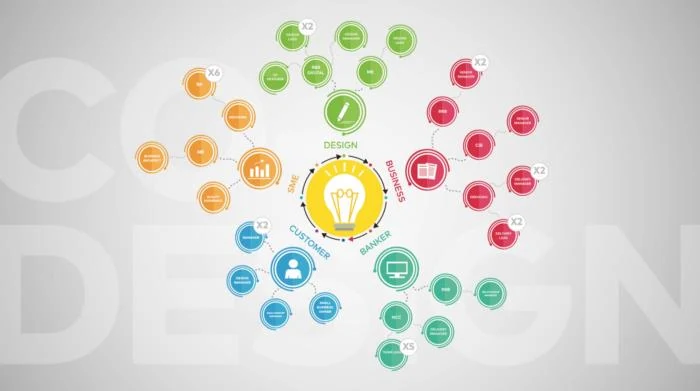
From the initial investigation and research it became clear that, because of the number of business units involved in providing the end product and service to clients, we needed a holistic design thinking approach, a service design approach, rather than a UX and UI focus alone. We had to broaden our scope to involve every business unit and include their input, so that we could frame the end-to-end product and service journey, made up of every touchpoint of every party involved, at any stage of the client’s journey.
We had to focus on solving the cause of the problem, not the symptom.
Core activities
- Research: data collection and visualisation.
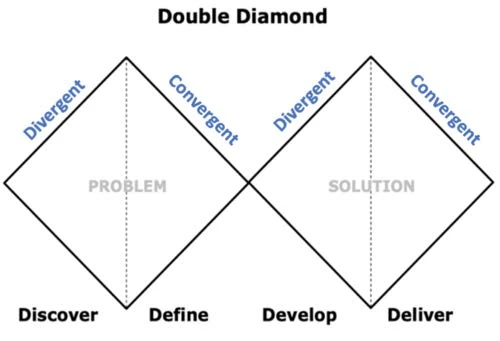
- Ideation: generating ideas (divergent thinking) and reducing options (convergent thinking).
- Prototyping: service processes and experiences, from current-state to future-state ecosystems.
- Implementation: service design, UX design, UI design and development.
We used the double diamond model for problem framing and solutioning.
The problem
Through our investigation and research, we were able to establish not only the origin of the problem, but also the disconnect between internal relationships and processes that had originally been put in place as a solution, and that now contributed to the problem.
The biggest and most pertinent problem was not the front-end systems and platforms bankers used, but the disconnect between internal business units, processes and delivery teams, all of which operated and communicated in silos. Adding to the problem, though, were the outdated legacy systems and front-end banker platforms used across the client service journey.
The solution
We needed to start discussions with the heads of the business units within Nedbank. It was vital to get them on board, accepting of and aligned to design thinking methodologies: focusing on what the client needs, not on what the business wants. It took a lot of perseverance, time and hard work, but we not only gained their acceptance of design thinking, we also earned their respect and involvement by including them in every step of the service design journey.
With the heads of the business units on board, we used the current-state ecosystem map and architecture as a starting point to pinpoint where, why, how and when improvements should be made to internal processes. With every back-end business unit and process aligned and “talking the same language”, we could focus on what matters most: the client’s need for a banker who can provide a holistic, streamlined and efficient service in resolving their queries.
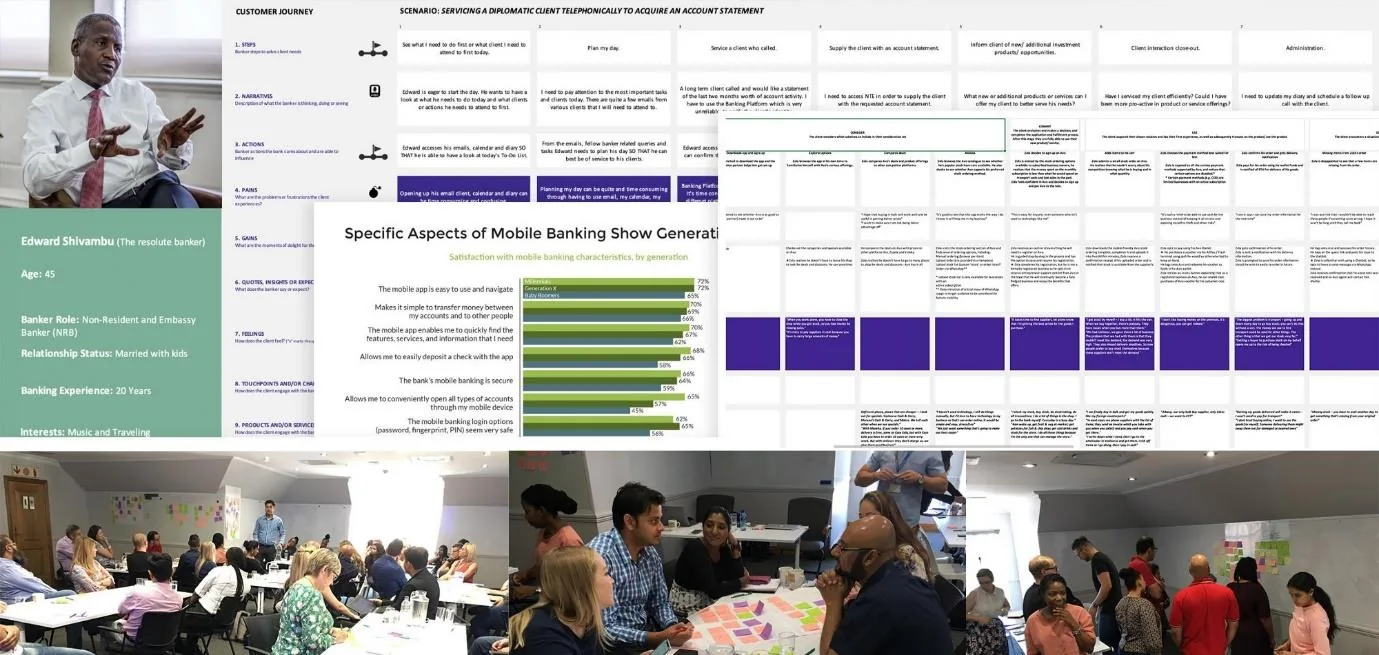
The cross-functional team of designers (UX and UI), business analysts, architects, developers and even project owners visited branches, observed bankers serving clients, and interviewed both bankers and clients. This gave us the qualitative research we needed to understand client and user frustrations, and to create personas, user journeys and detailed ecosystem maps. Ideation sessions followed, using divergent and convergent thinking, along with an iterative lean UX approach.
The project concluded with a newly designed, effective and user-friendly banker dashboard that enabled bankers to serve their clients far more efficiently. Behind that success are streamlined back-end processes and platforms, with business units now “talking the same language” rather than operating in silos.
Value and benefits
It was an immense privilege to be part of this game-changing team. Together we not only empowered our bankers to serve new and existing clients effectively and efficiently, but also embedded a lasting relationship with design thinking and an appreciation of its importance. Our approach and solutions helped Nedbank win an international award for “Most Innovative Bank” in both 2020 and 2021.
You can see the project itself in the Nedbank onboarding case study.
Key learnings
First, build trust: empathise and cultivate a relationship
Get to know your clients, and allow them to get to know you, both personally and professionally. Building trust and a relationship with the stakeholders involved ensures their acceptance of your proposition and intent. You’ll get nowhere trying to force your ideas and ideologies onto them.
Balance what the business needs with what the client wants
Although design should be client-centred, never forget that the tangible, measurable success (ROI) of your product or service depends on the fine balance between what the business needs and what the client wants. The client, in this case, still has the upper hand in business intelligence, experience and knowledge of their target market. Take this into account, and propose a solution that combines it with your own expertise.
Persevere
“It’s not about how hard you can hit. It’s about how hard you can get hit and keep moving forward.”
Rocky Balboa
I just had to quote Rocky here. Perseverance paid off on this project. We endured a lot of resistance to the client-centred design approach and to getting everyone on board, but it paid off. Don’t allow anyone, especially yourself, to question your methods and processes. You are capable, and you will succeed. Just keep pushing!
Embrace chaos, be open to change, and be flexible
Accept challenges and new norms. Be flexible in your approach to a problem, and embrace criticism. It is the only way to build new relationships, learn, adapt, and provide successful solutions to recurring and emerging challenges.
Service design is still underappreciated
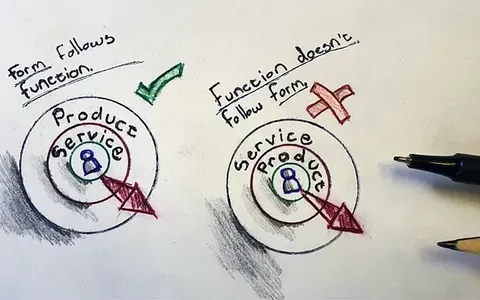
UX, CX, UI and product design cover the client’s journey through the touchpoints of a product or service. That leaves open the possibility of solving the symptom rather than the problem. Service design provides a holistic view of, and designs, the relationships between every touchpoint and every front- and back-end process on a client’s journey with a product or service.